

But the campaign is already underway.

Nobody has announced it yet — but just about everyone is running. To help you stay ahead, we’ve put together a behind-the-rope-line take on what to watch during this season of White House candidates pretending they aren’t running.
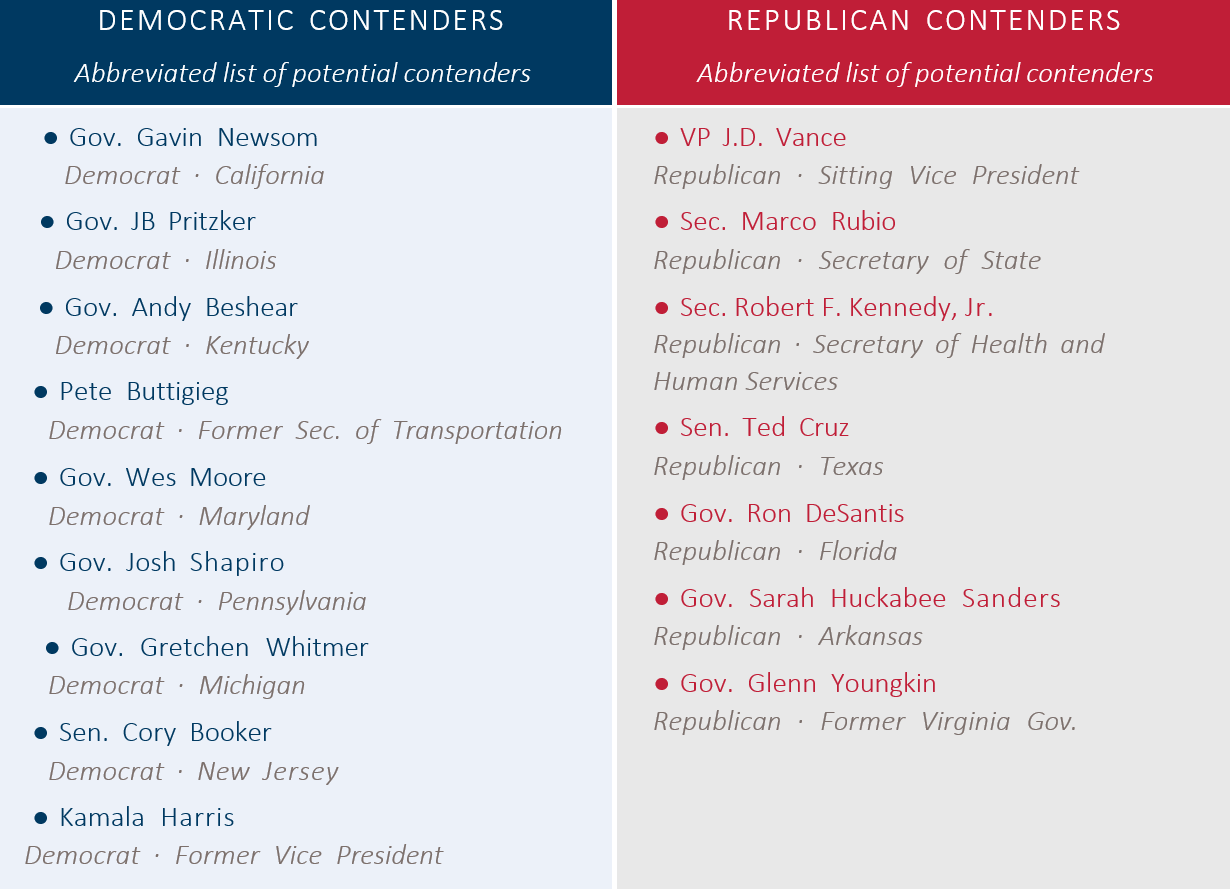
Although no major candidate has formally entered the 2028 presidential race, the outline of a presidential field is already taking shape — and it’s crowded, thirsty, and all over New Hampshire, Iowa, Nevada, South Carolina, and just about every other early or battleground state.
In modern American politics, presidential campaigns begin long before official announcements, and the earliest signals often appear in where ambitious politicians travel, whom they hire, how they raise money, and which issues they choose to emphasize.

As the 2026 midterm elections approach, both Democrats and Republicans are using those contests as a proving ground for 2028. The result is an early shadow primary in which governors, senators, current and former cabinet officials, and other national figures are testing messages, cultivating donors, helping allies, and building the infrastructure that could support a White House bid after the midterms.

TRAVEL AS AN EARLY SIGNAL OF PRESIDENTIAL INTENT
Travel is often the clearest public sign that a national politician is considering a presidential run. Over the past year, potential 2028 contenders in both parties have increasingly appeared in early-voting states and competitive battlegrounds. These visits serve two purposes at once: helping the party in important 2026 races while also introducing themselves to activists, donors, and local leaders who matter in the presidential nominating process.
THE QUIET CONSTRUCTION OF CAMPAIGN INFRASTRUCTURE
Before a candidate declares for president, advisers and allied committees often begin assembling the machinery needed for a national campaign. That includes bringing on political consultants, expanding digital operations, acquiring donor lists, refining issue messaging, and strengthening leadership PACs.
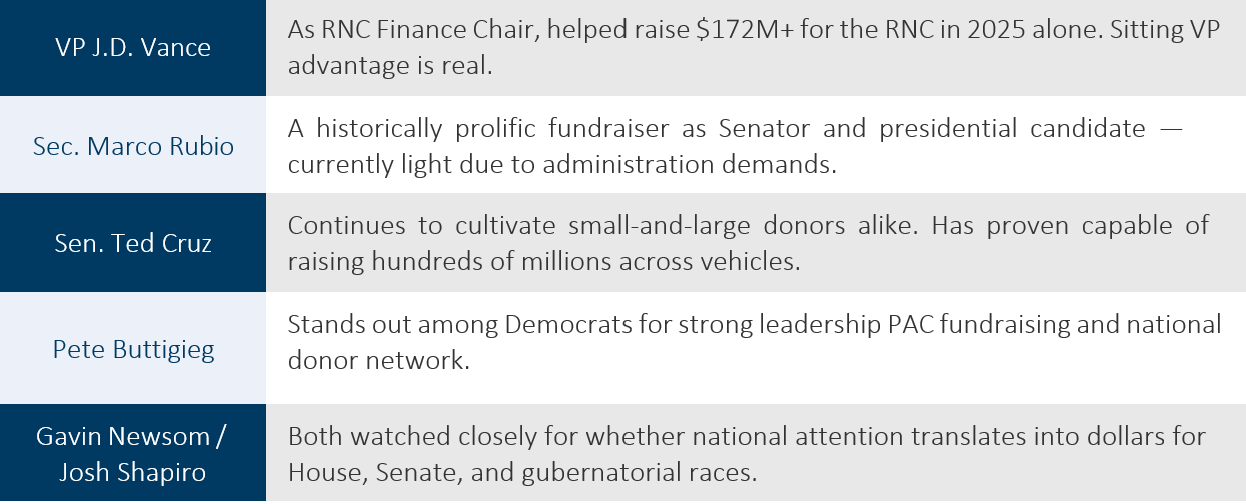
Recent campaign-finance reporting has shown that several prominent Democrats seen as possible 2028 contenders have already been raising and spending through leadership PACs in ways consistent with national ambition. Pete Buttigieg has stood out for strong fundraising, while governors such as Andy Beshear and Gretchen Whitmer have used PAC resources in ways that help build future donor networks and national visibility.
Republicans are doing something similar, though often through party networks, allied groups, and donor relationships tied to the post-Trump succession struggle. In both parties, consultant activity matters because it translates ambition into practical capacity.
MIDTERM FUNDRAISING AS A TEST OF NATIONAL STRENGTH
Fundraising for the 2026 midterm elections may be the most important bridge between today’s political maneuvering and tomorrow’s presidential contest. Prospective White House candidates gain leverage inside their parties by showing they can attract donors, distribute money to other candidates, and appear as valuable surrogates in competitive races.
THE LIKELY TOP ISSUES (HINT: IT’S STILL THE ECONOMY)
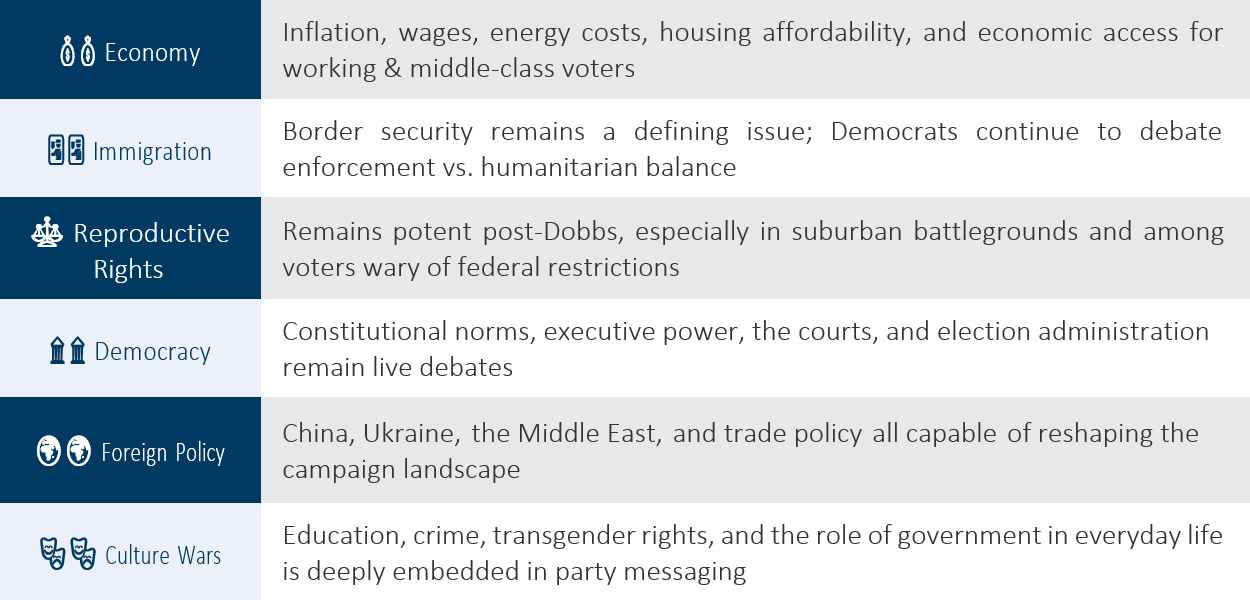
Several issues already appear likely to define the 2028 campaign. The economy will almost certainly remain central, especially questions involving inflation, wages, energy costs, housing affordability, and whether growth is reaching working- and middle-class voters.
Look for a big shift in how Democrats message kitchen-table issues, moving toward more “meat-and-potatoes” rhetoric on income, job security, pensions, and health care.
2028 WILL BE DIFFERENT
📱 Digital Campaigning IS Campaigning
Gone are the days of a Digital Department walled off in its own office and separated from communications, policy, and finance. Digital now envelops the campaign. It’s the town square where you introduce yourself to voters. It’s where you raise money. It’s your press briefing room, and it’s where you desperately try to be yourself and relate to voters. (Which is much harder than you think.)
Candidates who understand how to succeed in a digital, authentic environment are the only ones who can build a winning modern coalition.
📅 An Expensive, Voter-Rich Early Calendar
Look for Michigan to move way up in the Democratic primary calendar. It is a big, diverse, and expensive state in which to build an operation. Early money will be critical to have a fighting chance to compete for the estimated 56% of delegates up for grabs by Super Tuesday.
For Republicans, the path to the nomination is quite familiar: the Iowa Caucus → New Hampshire Primary → Nevada → South Carolina.
💼 You Seem Nice, But Tell Me About Your IE
In a post-Citizens United world, the role of an Independent Expenditure (IE) committee continues to grow at a staggering pace. According to the FEC, independent expenditures totaled more than $4.4 billion during the 2024 campaign cycle — up from $3.1 billion in 2020. Some of the top finance and digital talent may not join the campaign of their candidate of choice but rather hold out to run that candidate’s IE. In 2028, that dominance will likely set a new bar.
📺 The Cable News Primary
Likely candidates now measure their viability not by crowd size at a diner in New Hampshire, but instead by the engagement they get following a hit on FOX News or MS NOW, or by mentions and appearances on partisan podcasts and other influencer-driven media platforms. The cable news primary is where reputations are built — or destroyed.
🥡 Do Voters Want Leftovers?
A lingering question hanging over both parties’ nominating contests is whether voters will entertain supporting a candidate who has run before and is seen as a past cycle’s leftovers.
Voters tend to be attracted to a new and shiny object. Candidates who have run for president before must reinvent their message and rethink their approach. If it didn’t work last time, what makes you think it will be better in 2028?
ISSUE ADVOCACY IN EARLY STATES BEGINS NOW
Savvy organizations understand that engaging in issue advocacy in the early presidential nominating states pays dividends. By building a messaging presence in Iowa, New Hampshire, Nevada, South Carolina, and Michigan, you can engage campaign staff who will likely end up in the West Wing or in key administration posts, shape public perception, and engage activists whose voices will be heard by candidates and in media coverage.

Want to be first to receive news from The Briefing Room? Subscribe to the e-newsletter here. To learn more about Cornerstone’s Public Affairs and Strategic Communications offerings, please click here.